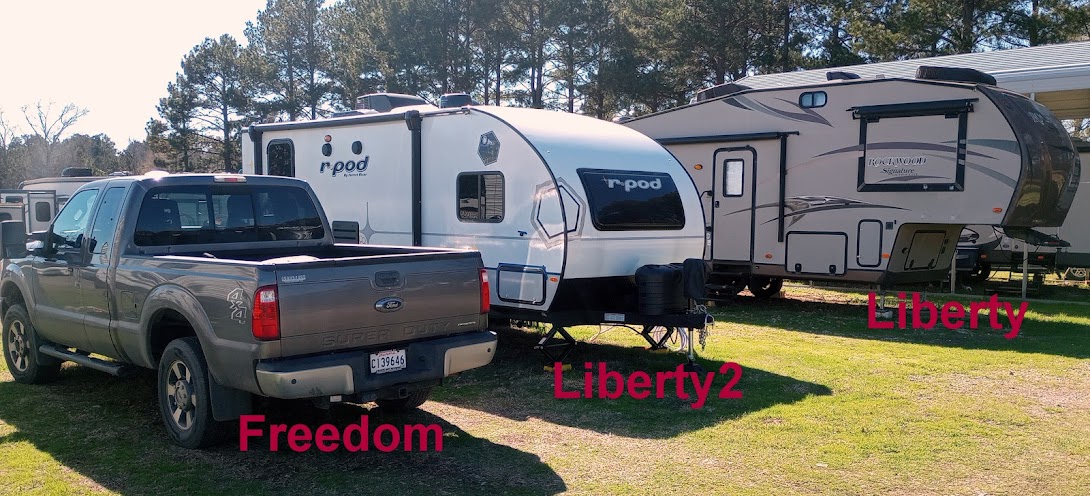
Wednesday, February 18, 2015

New Batteries, Finally

Location: Leaf Verde RV Resort (El. 1,000 ft); Buckeye, Arizona

(click pictures to enlarge)

I bought and installed the new batteries for Liberty yesterday. I will be writing about the where, what and why of the batteries in this post so I'll have a record of it in the years to come. For those not interested, now is the time to quit reading,,,:)

First let me qualify the things I'm about to say. I am not an electrical engineer and only have rudimentary understanding of electrical systems. Just enough understanding to not reduce the amount of times I get shocked. So here goes.

All RV's are a combination of AC current (like in your house) and DC current (like in your car). For example, in Liberty the air conditioners are AC and things like the water pump and lights are DC. The refrigerator and water heater are a little different in that they can run on either AC or propane, but when on propane, it needs about 1 amp of DC current every now and then. For the DC things in the RV to work while plugged in to shore power (AC), RV's come with a "converter/charger". It is used to convert AC power to DC power as well as to charge your batteries. So you see, if you always have electrical hookups, it is hard to tell what is AC and what is DC, because everything works without having to do anything special. In general, it is safe to say that the big power users like air conditioners, microwave, ceiling fan, electric water heater, etc need AC power while the smaller things use DC. So the next question is how do you use the electrical outlets, which are AC, to do very important tasks, like make coffee when boondocking (running on DC, batteries). That requires an "inverter", which is the opposite of the "converter" in that it changes DC current into AC current. Some RV's have large inverters installed so that everything runs in the RV when on batteries just the same as if it was connected to shore power. Liberty doesn't have an inverter so when I'm not plugged in to shore power, my AC things will not work. This means my coffee will have to be either, instant coffee using hot water heated on the stove using propane or an old fashioned "cowboy coffee pot". I used to have one of those many years ago when my family and I did a little, very little, tent camping. I do have a couple small, portable inverters that can be used to recharge my cell phone, laptop, etc.  

Like I said, when I'm plugged into shore power, everything works in Liberty because the converter is doing its job. The next term to learn is "boondocking". It simply means to camp without using shore power. That can be in the desert, National Forests/Parks, driveways, walmart, etc. There hasn't been a lot of boondocking opportunities for me since I have mainly been traveling in the eastern half of the country. I have never purposely been without shore power, therefore the one battery that came with Liberty was enough for my needs. That is about to change since I'm now in the western part of the country. There are many more places to boondock. Although I may try it for a day or two, I don't plan to boondock for extended periods of time in the desert. There are places where you can just drive out into the desert and camp. Usually for a maximum of 14 days. I'm pretty sure that type of boondocking is not for me. But what I am planning to do is to camp in some of the National Parks and National Forests. Many of these places have campgrounds but without services at the campsite, like power, water or sewer. They are mainly parking spaces in some very pretty settings. When you camp in those places, you need to have your fresh water tank full, your waste tanks empty and your batteries fully charged. 

The battery that came with Liberty is what I call a wet cell battery. It is the type that is usually found in your car, although this one was a little step above in that it was a marine battery. These type of batteries need to be checked on a regular basis and water added to them when needed. Of course, lazy ole me didn't do that because it didn't really matter to me at the time and by not doing so, the battery was probably on it's last legs. But now with some boondocking in my future, I needed a new battery. So, I did what every American does in a time like that; I Googled. 

I was looking for what type and how many batteries I would need for my boondocking plans. My plans are to boondock for a few days then go to a campground with shore power to charge my batteries while exploring that area. This means I won't need a generator or solar panels. I know from past experience that I can easily go 5 to 7 days on one tank of fresh water and empty waste tanks. So, that gave me a goal on how much power I needed in the batteries. There are a lot of terms in dealing with electricity, like Watts, Amps, Volts etc. After reading everything I could find and asking a couple questions on some Forest River online forums, for me and my simple mind, it all boiled down to Amp*Hours. Each battery has a certain number of amp*hours that can be used before it is dead. For example, if you have an appliance that is drawing a 5 amp current hooked up to a 50 amp*hour battery, then theoretically you can run that appliance for 10 hours before the battery dies. But, (there's always a "but" isn't there) generally if you drain a battery more than roughly 50% of it's amp*hours, you will shorten it's life span and you will be buying a battery sooner. Without doing too much heavy duty figuring and generously rounding up, I guessed wildly that I would need about 10 amp*hours per day. That meant for 7 days of boondocking, I would need a battery bank of 70 amp*hours. But, knowing that I don't want to buy batteries too often, I will only drain my battery bank about 50% so that means I need a battery bank of at least 140 amp*hours.

Next is the type of battery to buy. Being lazy, I want a maintenance free battery so I don't have to mess with it unless it stops working. The best type of maintenance free battery is an AGM (Absorbed Glass Mat). It was designed so as to not have liquid inside. This works great for airplanes and boats so the liquid doesn't spill out when they move side to side. These type of batteries can be mounted on their sides if needed. They also charge faster, have a longer life span and don't expel toxic fumes while charging like the wet cells do. That means the compartment you mount them in doesn't have to be completely vented since the AGM's only expel a little hydrogen while charging. The only negative thing about them is their cost; more than twice the cost of wet cell batteries. Let me say here, that if you are of the type that will check and maintain your batteries in excellent condition, have plenty of time to recharge and don't mind replacing them more often, then by all means buy the wet cell batteries as they will work fine for you, especially if you only use your RV occasionally. I personally went with the lazy man's option.  

So, I now know I need AGM batteries with at least 140 amp*hour capacity, but which brand, where can I buy them and can I install them myself? Again, after checking many sources, the brand most often mentioned as to the best in terms of  reliability, design, long life and durability was Lifeline Batteries with Trojan Batteries coming in a close second. Lifeline has an excellent webpage with information on everything about batteries. Very good source of information. Their webpage also listed their distributors. That does not mean those distributors keep batteries in stock. They are expensive and they don't want the overhead, so some only order batteries for the customer which may take a week to get in. I found that out in Tucson. But Copperstate Battery in Phoenix is a hub for Lifeline and they have some in stock all the time. I planned to buy two-12-volt Lifeline GPL-27T batteries that would give me a total of 200 amp*hours. When I got to Copperstate, they had just sold their last 27's to a commercial customer but they offered me their 12 volt GPL-31T's for the same price as the 27's. The two 31's gives me a total of 210 amp*hours. Remember though, recharging at 50% gives me about 105 usable amp*hours. They also made up some cables on-site for me to connect the two batteries in parallel. From high school science class, batteries in parallel adds their amps but not their voltage while batteries in series adds their voltage but not their amps. I wonder if they still teach that in school today. I could have went with 6 volt batteries with two connected in series to give the required 12 volts, but I decided to stay with the individual 12 volt batteries. 

Each GPL-31T battery weighs about 65 pounds. I decided to put them in the location where the original battery was placed. I toyed with the idea of moving them to a different location inside Liberty but decided against it. I turned the converter off at the breaker box, pushed the battery disconnect and removed the old wet cell battery. I checked the connections of all the wires and found one that was loose. Apparently it had been that way for a while. It looked as though whoever installed it had cross-treaded the nut and the connection was never able to be tightened. I didn't have one of those connections so I improvised and connected the wires directly. I think it will be ok, but time will tell. The lower part of the plastic box that the old battery was sitting in was bolted to the frame of the compartment with the bolt heads sticking up. I didn't like that set up because with the possible bouncing and moving around, those bolt heads could wear a hole in the plastic body of the batteries. I cut some 1X2 peices of wood and laid them in the bottom half of the old battery box to protect the new battery from the bolt heads. This set-up was very secure and would not move while I was traveling. I set the second battery next to the first and ran a strap around the old battery box and the second battery. I wired the batteries in parallel and turned everything back on. Nothing exploded or got hot after several hours so I guess I did the job good enough. 

After a couple of hours of buying, installing and one bumped head, I was in business. I even found a portable volt meter so I can check the status of the batteries from inside of Liberty. This is where it gets a little more confusing. Although, with me, it is all about amp*hours, the easiest and cheapest way to check the charge on a battery is by checking its voltage. Using the information provided by Lifeline, I will need to recharge when the voltage gets to about 12.2 volts. This morning, the volt meter was reading 13.6 volts which is in the range of the "float charging" of my converter/charger so I figure I'm at full charge. I verified the portable volt meter with my multimeter tester and they are within one tenth of each other, so I think I'm good.

I don't have any plans to boondock yet, but I'm set up and ready if one comes along. The weather plays a big part in boondocking too. Without A/C, I don't want to boondock in very hot weather and without being able to use my ceramic heaters due to the power draw, I don't want to camp in freezing weather either. We will see how it all pans out in the future. 
The original wet cell. It's the best picture I could get with the battery still in place.

The old battery and battery box has been removed and the picture is of the wiring. The little connector in the middle is the one with the cross-threaded nut. The name on the side is a "short-stop". Hopefully, I won't need it. 

The two batteries are installed and all wiring completed. I think it will work just fine.

The portable volt meter plugged into the cigarette lighter inside of Liberty. The 13.6 volts has been steady since last night.

A picture of the campsite. The batteries went inside the door beneath the king-pin overhang. That is where I bumped my head. It will heal up in a couple days, until then, I can wear a hat. :)
I'm sorry for such a boring post, but I needed this written down for me, and others may find it interesting too.  

Ya'll take care of each other. I'll Cya down the road.  


Monday, February 16, 2015

Hello from Buckeye, Arizona and a Sunset

Location: Leaf Verde RV Resort (el. 1,000 ft); Buckeye, Arizona

(click pictures to enlarge)

Today was moving day and I ended up in a fancy RV park in Buckeye, Arizona. It is located about a dozen miles west of Phoenix. It is a big campground with about 388 campsites but it doesn't feel too cramped. The park is about 90% full and most of the campers are snowbirds that came to Arizona to escape the winter. A rough calculation puts the campgrounds monthly gross income around $300,000.00. One thing unusual about this campground is that for $10.00 you can wash your RV at the campsite. I tried washing Liberty at Choke Canyon State Park but got busted and scolded for doing so. I paid my 10 dollars up front because Liberty is in bad need of a good washing. She has been carrying dirt from the oil field boomtowns of Texas for weeks. The campground is located far enough away from Phoenix that it borders the desert on the back. I took a walk into the desert to see what the sunset would be like. This part of the desert if full of Creosote Bushes which fill the air with their fragrance. It is nice but they need to change the name of the bush since it doesn't smell anything like the creosote plants back in Louisiana. :)There were a couple good pictures. 

I also chose this campground because it is close to where I need to get some batteries. It seems I've been stymied at each stop when I tried to get my batteries. In Tucson, none of the big battery distributors carried the batteries in stock because of the expense. I could have ordered them and had them delivered in a week but I didn't order them since the main depot was in Phoenix which was my next stop. 

I'm not sure what needs exploring in this area since my main thoughts have been about the batteries. If all goes well with the battery installation tomorrow, then I'll do some checking into exploration possibilities. 

This is a short post with only a few pictures. If I think about it, I'll take pictures of the battery installation tomorrow. It will be good to document how I screwed up upgraded Liberty.


A nice hill/mountain along I-10 between Tucson and Phoenix.

I've become addicted to sunsets. My Accuweather app on my cell phone has the time of sunset and sunrise for whatever area I'm camped. This one isn't as spectacular as I expect some of the future ones will be. 

The sky continues to change for about 30 minutes after sunset.

A nice Saguaro posed for this one. The sky was brightening up nicely. 

A road to be ridden into the sunset????

Ya'll take care of each other. I'll Cya down the road.

Sunday, February 15, 2015

Goodbye Tucson and People Watching

Location: Pima County Fairgrounds RV Park (El. 3,100); Tucson, Arizona

(click pictures to enlarge)

I went to the Pima Air and Space Museum and at first, I really didn't care for it too much. That bothered me because museums are usually right up my alley. After thinking about it, I guess I was just burned out on air museums since this was my third and they are mostly all the same. So instead of focusing on the displays, I people watched and eavesdropped instead, which proved much more interesting. I would hang around and try to listen to what the people were saying about some of the displays. Sometimes they would go up to the planes and touch them as if they were making a connection with the past or with people that had passed. It was more enlightening than seeing the planes and stuff. It was a reminder that memories are magical and if we can hold onto ours until the end, then that is just lagniappe (for my yankee friends, that means "a little something extra").


Nice entrance. Most of the people were either WWII or Vietnam era people. 

A replica of the Wright Brothers first airplane from 1903. We were all taught that the Wright Brothers flew the first airplane. However, there is some doubt about that now. Apparently a fellow named Gustave Whitehead flew a plane in Connecticut 2 years before the Wright Brothers. There is supposedly photographic proof of Whiteheads flight. Jane's All the World's Aircraft  is the foremost publication on all airplanes and they officially recognized Whitehead as the first in their 2013 publication. The Smithsonian has refused to follow suit but they seem to have a conflict of interest. The Wright brothers estate donated the Wrights first airplane to the Smithsonian with a stipulation. The stipulation was that if the Smithsonian ever recognized anyone other than the Wrights as being the first to fly then they would lose the airplane. Why would the Wrights make such a stipulation way back in 1948 unless they knew something they weren't telling. News like this just makes us more jaded than we are already. 

This Vietnam era helicopter got a lot of attention. The following were some quotes from people I overheard:

"This baby saved my life more than once".
"Yep, this is what he was flying when he was shot down".
"We sure were glad to see these show up".

A World War II bomber.

"Your granddad flew in one of these".
"He said he bailed out, but not sure if it was like this".
Planes everywhere. This is just one small section.

What started out as a boring exploration of the museum turned into an experience well remembered. 


I had forgotten to get a picture of the campsite. The campground is barebones and a little crowded but it has full hook-ups and very reasonably priced. It was worth staying here as the home base to explore the area. 

Tonight's sunset. Not the best, but it will do for now.

Tomorrow is moving day. I'll be heading about 160 miles north to a campground about a dozen miles west of Phoenix. I have reservations for 4 days there. The weather will dictate what direction I go after the 4 days. 

Ya'll take care of each other. I'll Cya down the road.

Thursday, February 12, 2015

Tombstone, AZ; The American Dream

Location: Pima County Fairgrounds (el. 3,100 ft); Tucson, Arizona

(Click pictures to enlarge)

When you think of Tombstone, AZ, you think of Wyatt Earp and his friend, Doc Holliday. That is because books were written and movies were produced about Earp which made him appear larger than life. It is said that there is more fiction than fact in most of them. The books didn't become best sellers until after Earp died in 1929 at the age of 81. Doc Holliday had the more exciting life compared to Earp but it was much shorter since Holliday died of tuberculosis in 1887 at the age of 36. While Earp was tramping around the mid-west doing odd jobs and sometimes lawman work, Holliday was graduating from dental school in Philadelphia at age 21. Holliday gave up dental work and pursued a life in the west as a gambler and gunman. They met in west Texas in 1878 when Earp was tracking an outlaw around Fort Davis (yep, the same place I was at a couple of weeks ago). Holliday told Earp where the outlaw was hiding out and that sealed their friendship. Two years later, both are in Tombstone, which was a silver mine boomtown. They were there to "mine the miners", which was done by gamblers, saloon women, thiefs, shopkeepers, etc. This happened when the miners brought their ore or wages into town. It was 1881 when a feud between Earp and some other men in the tombstone area erupted in the "gunfight at the OK corral". The story of this fight, with its many different versions, is what made Earp and Holliday famous.

But the real American Dream story of Tombstone that very few people know about is that of the founder, Ed Schieffelin. Ed was born in 1847 in a small town in Pennsylvania. Thirty years later he is scouting for the U.S. Army in southern Arizona. But scouting is only a means by which he can travel the area in search of gold or silver. He tells his Army friends he is out looking for "stones" and they tell him the only stone you will find with be your "tombstone". Well, Ed did find silver, but was too broke to do anything about it so he left the Army and went in search of his brother who was also a miner. All the while, he is hoping no one else finds the same silver because he was not able to file a claim on it. He found his brother and with the help of another man, they file the claim and begin mining. It becomes the biggest silver strike in the southwest at the time. People from around the country flocked there to find their riches by either mining or mining the miners. To service all of the people, a town is formed. As a joke, Ed recalls what the soldiers told him, so he named the town Tombstone. If Eds story ended here, it would be enough to satisfy the american dream, but it isn't finished yet. Ed, now in his mid 30's, becomes a wealthy man and moves off to California with his new bride (maybe another miner of a miner?). He gets bored of the easy life and leaves California and heads to Oregon, on his own, to prospect for gold. I guess the wife didn't want to give up the city life. It is in Oregon where he dies, alone, in a cabin up in the mountains at age 50. On the worktable that he is slumped over upon his death is gold ore. The last statement in his journal was, "Struck it rich again, by God". There were no clues as to where he found the gold ore and although many people looked, the source was never found. Ed's last wish was to be buried in Tombstone, dressed in the clothes of an old prospector with his pick and canteen in the coffin with him. That's where his grave is today. 

The story of three men, all in their early to mid 30's, whose lives converged in the town of Tombstone, Arizona in the early 1880's.
The streets of Tombstone

The famous Bird Cage Theatre

It is mostly a tourist trap sort of town now-a-days, but it is interesting to see the place and remember the history. Most of the stores are souvenir and eating places.

Three of the actors portraying the Earps and Holliday.

Tombstone was the county seat for a while and this was the courthouse. Today, it is a pretty good museum.

Picture of the miners at work. They earned $3.00 a day. To follow the silver, the mines eventually went vertical. After not being about to control the influx of water in the mines, they were closed. 

For any man or woman that rides horses, they may find these old saddles interesting.

The stagecoach, which you can pay and ride (I didn't) and the actors in the middle of the street. The "shoot out" doesn't happen in the street anymore. I guess there were too many people getting a free show so now it occurres behind a fence which you have to buy a ticket to see. Less authentic, but more profitable?

I found some "thinking benches" with a western style.

A good picture of the stagecoach

The saloon where I had my lunch with a cup of coffee on the side :)

Ya'll take care of each other. I'll Cya down the road.

Tuesday, February 10, 2015

A Drive and Walk among the Saguaro in the Sonoran Desert

Location: Pima County Fairgrounds (El. 3,100 ft); Tucson, Arizona

(click pictures to enlarge)

I toured the Saguaro National Park today. Saguaro is pronounced (sa-WAH-row) and they mainly grow only in this area of Arizona. For some reason this cactus has come to represent the west, specifically, the old west.
One of the main symbols of the old west? 
Sanguaro's can live to be over 150 years of age. The one in the picture above is close to that age because it has many arms. The arms first appear between 60 and 75 years of age. The park is full of all sorts of other desert plants. There is an 8 mile driving tour with several places where you can stop and walk into the desert. I took one of those walks to an old homestead place. I can not understand why someone would homestead such a barren place unless they were looking for solitude. 

The jury is still out whether I like the desert or not. It is said you either love or hate the desert. On a scale of 1 to 10 with 10 being "love the desert" and 1 being "hate the desert", I guess I'm about a 3 or 4. This is one of the things I was curious about finding out about myself when I was thinking about visiting the desert several years ago. I guess I'll know soon if I will be spending more time in the desert or passing through quickly. 

The Saguaro National Park Visitors Center. I toured a little museum inside and bought a couple post cards.

A few Saguaro standing proud

This one had the most arms of any that I saw. It was on the right side of the road and I wasn't able to stop so I snapped this quickly

Notice the holes in the Saguaro near the top. Those are bird nests.

A field of Saguaro

When the Saguaro die, they lose their "skin" and what is left is their wood-like ribs. It will take a few years but eventually, it will fall over and deteriorate.

Entrance to the Homestead "walk". It was about a mile walk, round trip.

The typical desert landscape along the walking trail.


This the mountains to the south of the campground. The setting sun wasn't too pretty, but the reflections on the southern mountains made them appear almost artificial. It was as those they were painted on a giant canvas. It was pretty and interesting. I'll be looking for more of this in the future, not only here but elsewhere as I pass through this desert terrain.
Ya'll take care of each other. I'll Cya down the road.


Monday, February 9, 2015

Great Weather and a Long Haul to Tucson

Location: Pima County Fairgrounds (El. 3,100 ft); Tucson, Arizona

(click pictures to enlarge)

I left El Paso early this morning with the intention of stopping a couple hundred miles down the road. I had even called ahead to make sure there was room in a campground in the little town of Bowie, Arizona. My plan was to stay only one night before moving on to Tucson. About 50 miles down I-10 I got into the open flat land of New Mexico and started seeing warning signs about dust storms. I had heard they could come up on short notice and could be blinding. As I got closer to Bowie, I started having thoughts about continuing on to Tucson even though it would make for a 300+ mile tow. The weather was great in the low 70's with NO wind. I figured I should get across this dust storm area of southern New Mexico and parts of Arizona while the getting was good. Freedom was having an easy go of it in the flatlands although she had to pull a long 8% grade across the Franklin Mountains north of El Paso. So, after filling up with fuel, and 60's/70's music blaring on the radio, we hammered down towards Tucson. I'm glad we did, it was a long haul but glad to be here. 

The plan is to get batteries here as well as exploring the area. I was planning to stay about 5 days but they told me I could stay 7 for the price of 5 so 7 it is. The campground is at the fairgrounds and is barebones. I have 30 amp service, water and sewer in a parking lot setting. It is about 15 miles south of Tucson so it is close enough for me. I'm satisfied. I forgot to get a picture, so that will have to wait for another post. 

I will also use the time here to do a little planning as to what things I want to see along my route this year. The general plan is still to head towards Crater Lake in Oregon then hang a right turn towards South Dakota then drop back down to New Mexico in the fall then over to Louisiana for Thanksgiving. Remember, that is all a general route only. If ya'll have any suggestions on things to see along the way, please let me know. 


Those are the Franklin Mountains north of El Paso. There is a long 8% grade up one side then down the other. I went this way to avoid construction traffic on I-10 through El Paso. 

Now this is a welcome sign. It is the best I've seen from any of the states so far.

Typical landscape for southern New Mexico and Arizona

One of the many warning signs about dust storms

Kind of a let down after the big overhead welcome sign for New Mexico

This is the rest area about 20 miles south of Tuscon. It was a 2 rest area and 1 fuel stop haul today. The rocks were unusual and only occurred around this rest area.

This is the same rest area. I included the picture here because I liked the glare made by the sun on the upper left. I didn't notice it until I downloaded the pictures to the laptop.

Ya'll take care of each other. I'll Cya down the road.

Sunday, February 8, 2015

Moving day to El Paso

Location: Mission RV Park (El. 3,800); El Paso, Texas

(click pictures to enlarge)

It was a 213 mile tow but the weather was great. I enjoyed seeing the landscape change again. I have been following the Rio Grande north ever since I left Falcon State Park 2 weeks ago. With every move, the landscape and topography changes. It has been interesting seeing the changes. I'm also now in the Mountain Time Zone.

I don't have anything planned to explore in El Paso. It is more of a layover for me on my way to New Mexico/Arizona. After setting up yesterday I did have enough time to go on the Scenic Drive on the edge of the Franklin Mountains that overlook El Paso. On the way there, I go hung up in some interstate construction which turned into a stop and go situation. 15 miles and an hour later, I found the exit I was looking for that would lead me to the Scenic Drive. I got a little lost, twisted around,  misplaced, geographically inconvenienced and took a tour of some places that would have been considered "off limits" if I was on liberty in the Navy. But I eventually found the drive and made it to the scenic overlook. It is a nice view that overlooks all of El Paso, Texas and Juarez, Mexico. El Paso is the 6th largest city in Texas with houses and businesses very close to each other. Quite a change from the open spaces of the state parks that I have been staying. 

I will only be here for 2 nights before moving on. I had planned to get my batteries here, but I got "bad vibs" when I drove by the area where the battery store is located. Over the years, I have learned to trust my "vibs", both good and bad. Tucson is the next city that has the type batteries I need. Getting them immediately is not critical, so I will wait and see what Tucson feels like. I will use my time here in El Paso to go to Walmart for supplies and maybe a haircut and laundry if the mood strikes me. 

A few pictures from the trip and El Paso.
The hills and landscaped changed.


More landscape.

This is for my Louisiana friends. That junction is the I-10/I-20 junction. The point where I-20 begins. A right turn and I would be back in Shreveport after about 700 miles.

Yep, this is a bathroom. My second, and hopefully last, bathroom picture from my travels. I will let ya'll try to remember the first one. This is the men's room at the rest area just east of El Paso. The stalls are immediately to the left and there is only half a roof. I guess if it is raining you need to wear a rain pancho if you need to go. It was surprising. 


You can see how the land has flattened out more in this area of Texas. There are mountains, but they are clustered together and are not wide-spread.


A look at El Paso from the Scenic Drive overlook. In the background is Juarez, Mexico. You can see the giant Mexican flag in the top center of the picture.


I parked Liberty over yonder. :)

Ya'll take care of each other. I'll Cya down the road.