Friday, May 16, 2014

Arlington Cemetary

I left the campground in the Shenandoah Valley around 10:00 a.m. on Tuesday the 13th. I had to put all of that information in the blog to refresh my memory of when and where, because the days have been blending together lately. Between retirement and traveling so much, time seems to have slowed down considerably. When I was working, time was measured by landmarks such as weekends, paydays, special events and holidays. The days in between those landmarks were usually very similar to each other so after a couple of landmarks, you would look and see that a month or a year had passed. Now, by seeing new things more often, my landmarks are closer together so the perspective of time has changed for me. Anyway, I arrived in D.C. around 1:00 p.m. after going through a construction work zone on the interstate that was wrong in all aspects, from the construction signs to the quality of the roadwork. I was going slow enough that I could roll my window down as I passed some state inspectors and hollered at them about the piss-poor condition of the work and the wrong location of their construction signs. They politely waved and smiled. I'm sure they were going to immediately take corrective action. Right??
Site 32 Cherry Hill Campground


I checked in to the Cherry Hill Campground and was assigned site number 32. During check-in, they informed me
Metro Train Entrance/Exit
of a class that I should attend about how to ride the city buses and trains. I thought it a little odd, but after getting the RV set up I was sitting in the classroom 15 minutes early. I haven't broke the habit of "15 minutes early is on time and if you're on time then you're late". The lady went over the bus schedules and told us which buses to take and which ones would take us to the wrong part of town. We're lucky that the campground has it's own bus stop and is on the end of the line. A bus leaves and arrives at the campground about every 30 minutes between 5:30 a.m. and 10:00 p.m. We are to take the bus to the College Park Metro Station where we would catch the subway/train. There are 5 train routes in the city and each are designated by a different color. To determine the direction you want to go you have to look at the last stop on that route. Each route has about a dozen or so stops. It is actually  pretty easy after doing it once, but a little confusing at first. I asked the lady giving the class if she was going to safety pin our bus number to our shirts. She gave me a funny look and if I could read her mind she was saying, 'yeah, and you're the one that is going to end up at the Rhode Island Road bus stop (the one we definitely didn't want to go to)'.

The next morning I showed up a the bus stop bright and early around 9:30. If you go into town any earlier, you have to deal with all of the people going into town to work.

Today's adventure was to be Arlington National Cemetery. The Cemetery had it first burial 150 years ago this month and is definitely sacred ground. To get there, I would have to ride one bus and two trains. The Arlington Metro Station is located about 1/4 mile from the entrance. The bus ride went well, although it was standing room only by the time we got to the College Park Metro Station. Once in the station, I had two choices of directions. One would take me into town and the other would take me away from town. I got on the Green line heading to Branch Avenue and planned to get off at L'Enfant Circle and change trains to the Blue line heading to Franconia-Springfield and get off at Arlington Cemetery. I chose the correct direction and headed off. It was a little different once I got to L'Enfant Circle where I needed to change trains. There were 4 routes that went through L'Enfant with 2 directions per train, so that meant I had 8 choices. At least at College Park I had a 50% chance of making the correct choice but now it was 1 in 8 or 12.5% chance. Visions of an antelope in lion country on the plains of Africa came to mind as I wandered around the station looking for the correct train. I walked confidently, even when I made U-turns, so it would appear as if I knew where I was going and what I was doing. I finally found the right platform and got on the train. A few stops later, I arrived at Arlington Station and walked up out of the darkness of the tunnels into the light.

As you enter the cemetery, you have to go through the visitor center. This is also the first place that had a bathroom
Visitors Center
since getting on the bus earlier; something the woman that gave the class should have mentioned, but didn't. I bought a ticket for a bus tour of the cemetery and the first stop was the Tomb of the Unknowns. The soldiers, in dress uniform, have guarded the tombs 24 hours a day, every day, since
Tour Bus
1937. They change out every 1/2 hour during the summer days and every hour during the winter days. At night they stand a 2 hour shift. The soldier takes 21 steps as he marches back and forth and as he turns to head back he waits 21 seconds before each executed turn. The gun, with bayonet, is always carried on the shoulder
closest to the crowd to indicate he is in a defensive posture to protect the tomb from possible harm. 

The Tomb of the Unknowns began in the 1920's with the
remains of an unknown soldier from World War 1. In 1958, President Eisenhower added the remains from World War 2 and Korea. President Reagan oversaw the internment of the Vietnam unknown in 1984 but 10 years later the body was exhumed after it was identified using
Relief Guard being Inspected
DNA. The Vietnam crypt remains empty and will remain so. It is a very solemn place with a lot of people visiting the site. I was proud to see the respect that everyone had, including the hundreds of children that were there on school trips. The inscription on the Tomb reads,
The changing of the guard

"Here rests in Honored Glory an American Soldier Known but to God".


The next stop on the tour is Arlington House which was the home, for 30 years, of General Robert E. Lee and his
View from Arlington House
wife. Apparently, the General married a rich widow named Mary Custis Lee. She was the great grand-daughter of Martha Washington (from her first marriage). Most of what is now Arlington Cemetery was part of her estate that had been handed down from Martha. No, Mrs. Less didn't donate the land, it was taken
View from Arlington House
from her by the Federal government for back taxes. Her husband, General Lee (colonel at the time), resigned his commission with the Union Army in order to lead the Virginia Army. After burying several valuable items around the property, she joined Lee in Richmond, because they knew the Union forces would not permit a southerner from occupying the high ground overlooking the Union Capital. Sure enough, the union forces took over the place and stayed throughout the war. A law was later enacted which stated 
Gardens of Stone

that property taxes must be paid "in person". Well the Lee's knew if they showed up to pay the taxes, they would be captured by the Union soldiers, so they sent a representative with the $92.07 for the taxes. The government would not recognize the representative and therefore foreclosed on the property. Burials of Union troops began shortly afterwards,
in 1864, with the plan to bury as many as possible before the end of the war. If the Lee's were able to return to Arlington House, then they would have to live with Union troops buried around the house. The Lee's never returned and never regained 
U.S.S. Maine Memorial

possession of the place. However, several years after the war, their son filed suit and the U.S. Supreme Court ruled that the government did not acquire the property correctly and ordered it to be returned. The son then sold it to the government for $150,000.00.

Arlington is truly a sacred place and should always be treated with honor. As I was looking over the many head stones, I was reminded of some of the lyrics to Trace Adkins song Arlington. If you haven't heard the song, it is sung from the perspective of a person being buried at Arlington. The part I thought of goes, "And I'm proud to be on this peaceful piece of property. I'm on sacred ground and in the best of company. I'm thankful for those thankful for the things I've done, I can rest in peace, I'm one of the chosen ones, I made it to Arlington."

I discovered there is one Goza buried here. He was a Captain in the U.S. Navy and served in both WW1 and WW2. He was buried in 1964.

After the tour, I walked back to the Metro Station and returned to the campground late in the afternoon hungry and tired. I drove down the road looking for a Taco Bell but had to settle for a steakhouse. Next door was a Baskin-Robbins and I ended the day with a scoop of Butter Pecan which I ate sitting on a bench in a strip mall in Washington D.C. thinking about how good the day had been and looking forward to more adventures the next day. Wow, what a life.

Ya'll take care of each other. Cya.


Thursday, May 15, 2014

Not in a ditch

I explored Arlington Cemetery yesterday and got back late. I'm heading to the Smithsonian today. Will make a more detailed posting if I get back early or tomorrow for sure since it is suppose to pour down rain tomorrow.

Monday, May 12, 2014

Skyline Drive, Pics, Pics and more Pics

If you don't like pictures then exit out of this post now. I'm not sure if blogger will load them all or not, but I'm going to try to post 25 pictures. Some will have captions, but most will be just views from Skyline Drive in the Shenandoah National Park. Remember, click the pic to enlarge.

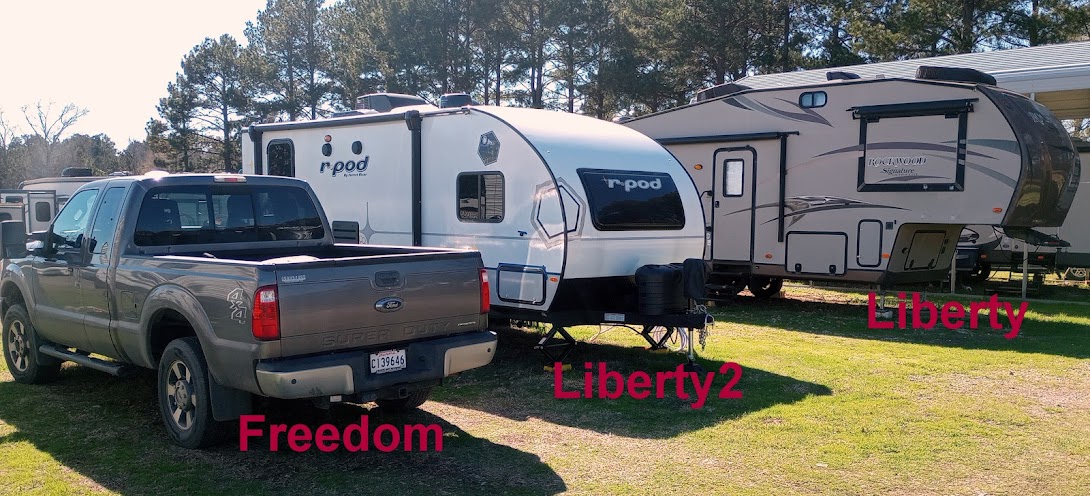
Freedom and Liberty leaving Appomattox, VA.


Freedom and Liberty in Mount Jackson, VA.


I need to go on U.S. Route 29 North. Do I turn right or stay straight? Something is missing. (lol)


An old covered bridge just down the road from the campground.


Headed to the mountains. The sky was beautiful today. The colors you see are real. No photo-shopping.


It was a good day. The sky was pretty, the temperature was in the low 70's, and the overlooks and roads were not crowded. I was told during the peak of the season, the overlooks are so crowded there isn't room to pull into some of them. Many times today, I was the only one in an overlook and was able to soak in all of what God has provided for us. It was literally "awe-inspiring".
 
Tomorrow is travel day. I should be in Washington D.C. by noon or a little after. I'll be there through the weekend and will see as much as my feet and fat belly will let me see.
 
Ya'll take care of each other. Cya.


Sunday, May 11, 2014

Mother's Day

I was my mother's baby and that is what she called me sometimes, "baby". She passed away in 1995, so for the last 19 years her "baby" has had to whisper Happy Mother's Day to her. Of course it doesn't matter if I whisper it or yell it, she hears it. My father joined her on the other side in 2002.

My mother was born in the Great Thicket of east Texas. I'm not real sure of the town, but my best guess would put it somewhere in the Jasper/Buna/Evadale area. As I was growing up, my mother would just tell everyone she was "from the thicket and they were so poor they didn't have a pot to pee in or window to throw it out". But one of the things she was most proud of was her perfect attendance in school. I don't remember the length of time but it was several years in a row. Education was important to her. She had two sisters, the oldest was Mildred, the middle was Dorthy (Aunt Dot) and my mother was the youngest, the baby. Her name was Susy, but her family called her Baby Ray, with Ray being her middle name. My father called her Sue, except when he would be teasing her about something then he would call her Susy. It seems strange to me now that she not only changed her last name when she married my father, but she also changed her first name. They both changed a lot after they married. That day was a changing point for both of them. Their paths joined and they began to carve out a future. My mother was the last sister to pass away. I remember her saying, as the time got short, that she would be joining them soon.

My mother and father met when my mother was 17 and my father was 20. The story as I remember it went something like this. The meeting was in a city, perhaps Beaumont. My mother was with her cousin Johnnie (female) and her boyfriend and they had come into the big city to see a picture show (movie). As they were walking down the street, my father was sitting on the hood of his car. As they passed by, he said "It doesn't seem fair, one guy with two girls." I'm not sure what happened next except it wasn't long before they were married. That marriage would have been in 1944. Together they raised three children. The oldest joined them several years ago.
My mother worked briefly as a telephone operator but once the kids started coming she stayed home to raise us. It was a time when there would be breakfast and supper every day no matter how tight the money. She was a great cook and I don't think she got enough praise or credit for that part. My father always had a warm meal waiting for him no matter how late he got home from work. I sure wish I could taste her Chicken Pot Pie, Roast Beef, Cherry Pie or Pecan Pie again. I don't even have the recipes. I figure the recipe was from Betty Crocker or some other source like that so every chance I get I taste Cherry or Pecan Pie in hopes that someone else is making it the same way. So far, no luck. Mom probably changed the recipe anyhow.

My daughter is having her first Mother's Day today. The first of many to come. She is a great mother and with her good husband will provide Olivia Grace with the love and stability that I knew as I was growing up.

I wish a Happy Mother's Day to every mother. Especially, the mother of my children who did a great job in raising our three children. Thanks Kathy. Also to my sister, Phyllis, who raised two children with the help of my brother-in-law, Sam.

Ya'll take care of each other. Cya.
 

Saturday, May 10, 2014

Appomattox Court House (The Surrender)

It was early April of 1865; General U.S. Grant's army has successfully captured Petersburg, VA which is a town just south of the Confederate capitol of Richmond, VA. Petersburg was the key to taking Richmond because the
Road leading to Appomattox Court House
railroad junctions in the city carried supplies north to the capital and General Lee's army which has been protecting it for months. Around April 3rd, Lee gets word that Petersburg has fallen and he orders the retreat of the Army of Northern Virginia to the west. This retreat gives control of all portions
Courthouse building at end of road
of eastern Virginia to the Union. Lee's plan is to retreat west to a point where he can receive supplies coming north through the Lynchburg area. Once re-supplied, he planned to turn south and join forces with General Johnston who had been operating in North Carolina after losing to the Union at Vicksburg, Jackson and Chattanooga. Grant, sensing the end was near, pursued Lee. 

Lee reached the Appomattox area and was given the bad news that the supplies and supply line he had been hoping
McLean House
for had been captured by the Union General George Custer. Realizing his men would not be able to survive without supplies and being cut off from retreating south, Lee sent a message to Grant asking for terms of surrender. Grant sent a message back outlining the terms and asked Lee to find a
McLean House
suitable site for their meeting. On April 9th, some of Lee's officers entered Appomattox Court House to find a meeting place. Although many of us were taught the meeting was actually in the courthouse building, it was not. Appomattox Court House (two words) indicates the area around the courthouse (one word). This area included several houses and stores. Since it was Palm Sunday, the
Room where the signing took place
courthouse building was locked and very few people were around. The officers found one man named Wilmer McLean and asked him about using one of the buildings. McLean showed them one building but the officers rejected it because it did not have any furniture. McLean then offered his own house
Painting of the signing (sorry for the glare)
for their use. Upon seeing the house the officers immediately accepted and returned to Lee and informed him they had found a place. Word was sent to Grant about the location who was already heading in that direction. On April 10, 1865, General Lee, with one aide, arrived at McLeans house first. He waited in
the parlor for about 30 minutes before Grant, with several
What was actually signed
aides, arrived. Lee and Grant had met once before many years before, during the war with Mexico. The two talked about those times for about half an hour. It was Lee who brought up the subject about the surrender. Grant told him the terms essentially remained unchanged from the day before. Lee accepted
Tavern where Paroles were printed
those terms and asked for two things. One, that the proceedings be put in writing and two, that his men be given "written" paroles. The written paroles would be needed so the confederate soldiers wouldn't be confused as being active soldiers after the surrender. Grant agreed to both items and immediately wrote a short paragraph summarizing the proceedings. He gave it
Printing press with Paroles drying
to Lee who added a shorter paragraph and that ended the meeting. The local tavern, behind the courthouse, was turned into a printing house and two printing presses produced 28,231 written paroles as promised by Grant. Once the confederates received their paroles, stacked their rifles and turned over their flags they were free to return to their homes. Nearly 30,000 men
A copy of a Parole
simply walked away, heading home. It was still several months before word would spread of Lee's surrender which would prompt the surrender of the rest of the Armies of the Confederacy, but this was the end. 

Interesting information: Wilmer McLean owned the farm where part of the First Battle of Bull Run was fought. This battle was one of the first of the war. He was too old to enlist, and being tired of war, he took his family to western Virginia in hopes of avoiding the war. He settled in Appomattox. It is a strange coincidence that he owned the land at the first battle and the house at the end.

It was a good day visiting a place I had heard about all my life.

Ya'll take care of each other. Cya.

D-Day Memorial

Since there weren't any pictures in the last post, there will be lots in this one. The morning started by driving about 40 miles to Bedford, VA. That is the home of the National D-Day Memorial as established by the Congress and dedicated by President George W. Bush in 2001. The population of Bedford is around 6,000. Why put such an important memorial in such a small town? Because proportionally, the Bedford community lost the most servicemen on D-Day than any other community in the country. I arrived about 30 minutes after it opened and was one of only about 10 other visitors. I like it like that, especially at a place that I expect to be solemn and somber with a lot of introspection. I was very surprised by the first
statue on the pathway leading to the site. It was located in the middle of the sidewalk so there was no chance of missing it. It was of a ghoulish figure that would probably scare children. Even after reading the plaque, I'm still puzzled why the figure is so ghoulish and in such a prominent location.


This year is the 70th anniversary of D-Day, which was the beginning of the end for Nazi Germany and Hitler. They had

controlled Europe, North Africa and the Baltics for almost 4 years. On June 6, 1944, the Allies began the liberation of Europe by sending 5,000 ships, 11,000 airplanes and 150,000 men

across the English Chanel to Normandy, France. It is the largest air, land and sea operation ever. Twelve


countries participated in the event. Hopefully, there will never be a need for another one.


The next picture is looking back toward the entrance from

the display. You are looking through the landing craft (Higgins Boat) which were designed and built in Louisiana. The depiction is of the landing itself, with the water in front and soldiers climbing the hills.

As you step backwards, the bluish colored concrete pavement represents the water as you approach the beach. To the right side of the picture is the section devoted to the Navy and to the left is the Air Force. Of course the center section is the Army. Behind me, in the picture above, is a statue of Ike surrounded by busts of his Generals.

My favorite General only has a plague and not a bust. He seems to have been marginalized even at a memorial in which he would have had more appreciation of its significance than some of the others represented by busts. 

Looking towards the memorial from Ike's point of view you can see the overall display. Notice how everything lines up on a straight line through the center.

The last picture is of the dedication engraved in the stone close to the entrance.


It is a very good memorial and I enjoyed wandering around it for a couple hours. It is a place where you can walk for a while, then sit and absorb it. It represents a significant event in not only our history as Americans but of the world.

Ya'll take care of each other. Cya.